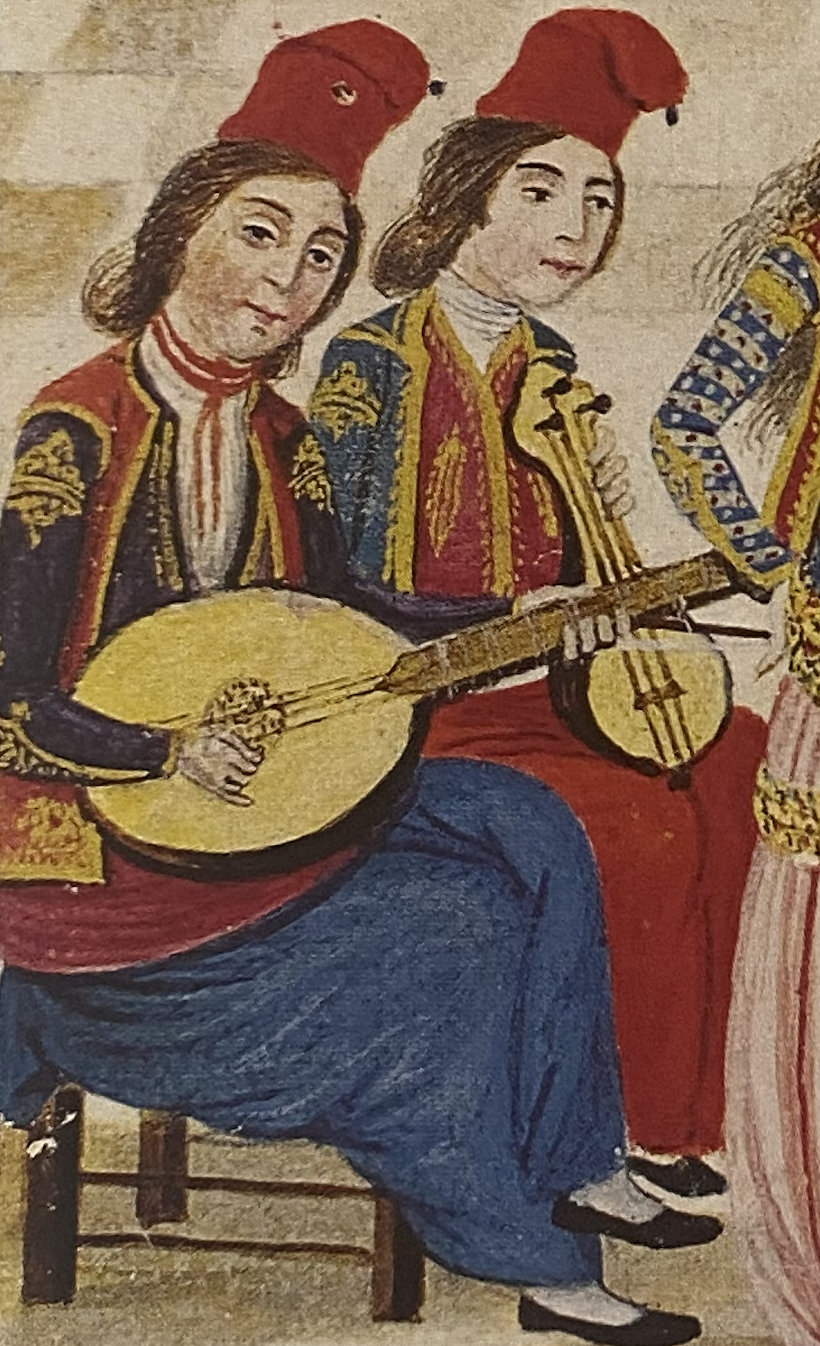
Ensemble Rûm’s instrumental practice is grounded in a dedicated research, design, and instrument-making project rather than in the substitution of modern instruments for historical names.
Musical manuscripts and edvâr treatises are surveyed instrument by instrument and set beside archival records, travellers’ descriptions, museum objects, and a corpus of nearly 700 miniatures. Written descriptions of form, materials, strings, tuning, and technique are compared with iconographic evidence for proportions, posture, and performance context.
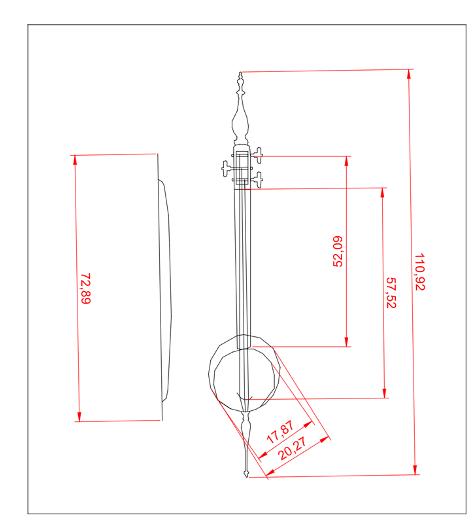
Approximate measurements and working plans are tested with makers and musicians. The resulting instrument is not a decorative copy of a miniature, but a playable research hypothesis refined through construction, tuning, rehearsal, balance, and repertory-specific use.
Because names, forms, and functions changed across periods and regions, no reconstruction is presented as the single definitive version. Incomplete and sometimes contradictory evidence is treated as an essential part of historically informed practice.
From measured drawing to playable research instrument.
Plucked strings
Setar
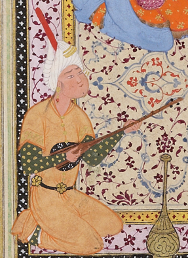
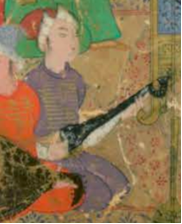
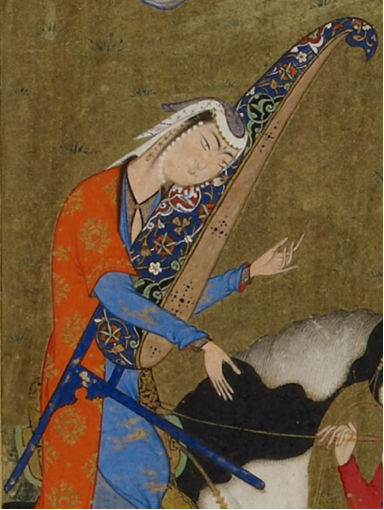
Bodleian Libraries, MS Ouseley Add. 24, fol. 175r — Pir Budaq b. Jahanshah with Qasem, 1552.
A long-necked plucked lute associated especially with Persianate musical culture. The ensemble currently uses a present-day Iranian setar as a historically related instrument rather than claiming it as a direct Ottoman reconstruction; its light articulation and intimate dynamic range are particularly useful in Ottoman–Safavid programmes.
A reconstruction of an earlier short-necked, fretless lute rather than a standard modern concert ud. Its design draws on sixteenth- and seventeenth-century imagery and written evidence concerning the ud’s compact neck, broad body, materials, stringing, and playing position. It contributes a drier, more immediate period colour while retaining the ud’s central role in modal development and ensemble continuity.
Eski Tanbur
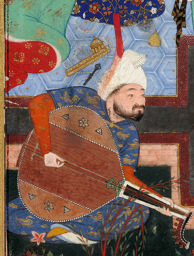
TSMK H.2162. Musician playing a Safavid six-stringed tanbûr (şeştâr) with a long tortoise-shell plectrum; early eighteenth-century Ottoman copy of a Safavid miniature painting from around 1600.
A reconstruction addressing the instrument’s form before the familiar eighteenth-century Ottoman tanbur became standardised. A pear-shaped body, thicker soundboard, and lower bridge—derived from period depictions and organological comparison—create a shorter, firmer resonance and change its articulation and balance within the plucked-string group.
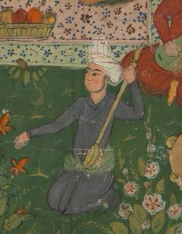
Tanbura
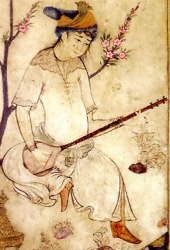
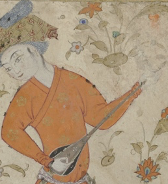
Rijksmuseum, RP-T-1993-462-(R) — Man in a red robe playing a siter-like instrument in a floral field, bordered with a gold and green foliate design. Persian miniature drawing, 1570–1590. Public domain.
A smaller long-necked lute reconstructed from sixteenth- and early seventeenth-century visual evidence as a possible precursor or close relative of the later Ottoman tanbur. It explores an earlier, lighter, and more agile branch of the tanbur family without claiming a simple linear evolution.
Kopuz / kopuz-ı Rûmî
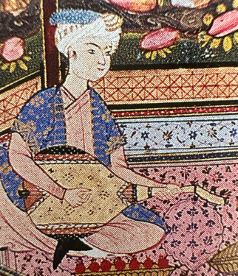
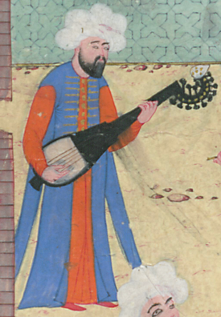
İÜK T.1975, Destan-ı Ferah ve Huma, Nakkaş Osman, c. 1601, nekty01975, fol. 10.
A short-necked, fretless lute reconstructed from Ottoman and Persianate written sources and sixteenth-century miniatures. Evidence points to a carved wooden body, a soundboard wholly or partly covered with skin, variable stringing, and a long, firm plectrum.
Şeşhane
TSMK H.1344, fol. 40.
A larger historical plucked lute studied in relation to the kopuz and to Evliya Çelebi’s terminology. Its size, stringing, and construction are developed comparatively and tested against seventeenth-century repertorial needs.
Şehrud
Harvard Art Museums / Arthur M. Sackler Museum, 1958.76. Complex Palace Scene, attributed to Mir Sayyid Ali, from the Khamsa of Nizami, c. 1539–1543. Public domain.
A large, low-register member of the ud family reconstructed from medieval and early Ottoman theoretical descriptions and miniature evidence. The playable model translates textual ratios, holding position, and practical string tension into a viable instrument whose deep resonance provides a bass colour absent from the modern standard ensemble.
A fretted plucked lute associated with Istanbul and the eastern Mediterranean, valued for projection, rhythmic clarity, and multi-confessional urban repertories.
Çeng
A historical harp documented in Ottoman and Persianate manuscript painting and written sources. The ensemble approaches the çeng through iconography—studying its curved neck, resonator, string layout, playing posture, and place in courtly ensembles—as a reconstruction and performance research project.
Zithers
Kanun
Freer Gallery of Art Collection — Folio from Haft paykar in Khamsa (Quintet) by Nizami, from manuscript F1908.199.
A plucked trapezoidal zither documented in theoretical and visual sources. The reconstruction project studies its historical geometry, stringing, and playing position before applying it selectively to repertories whose date and context support its presence.
Santur
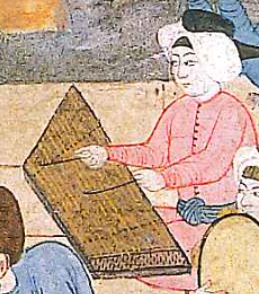
TSM 3594, fol. 139a — Santur, 1720.
A hammered zither relevant to Ottoman–Safavid contact and the connected musical cultures of the eastern Ottoman world. The ensemble currently uses a present-day Iranian instrument as a historically related performance resource, clearly distinguished from instruments reconstructed within the project.
A bowed instrument associated with Istanbul and the wider Ottoman world. The ensemble distinguishes later Istanbul practice from earlier forms documented in written and visual sources, testing construction, bowing, stringing, and playing posture against the repertory. Its focused sound is especially valuable in programmes concerned with the Greek-speaking lands of the Ottoman world, Ottoman–Venetian contact, and the eastern Mediterranean.
Kemançe
Walters Art Museum, W.623. Sultan Mu’izz al-Din is Reconciled with His Father, Nasir al-Din Bughra Khan, from Amir Khusraw’s Hasht-Bihisht. 1609 CE, Safavid Iran. Public domain.
A spike fiddle played vertically in Ottoman, Persian, and neighbouring musical cultures, used especially where the repertory points towards Ottoman–Safavid or wider eastern connections.
Wind instruments
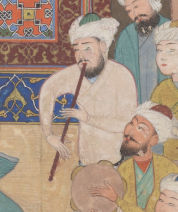
Ney
Chester Beatty Library, Per163_6_09353 — Sufis Performing Samāʿ Before Their Master Shaykh Niẓām al-Dīn Awliyā (d. 1325), from the Five Poems (Khamsa) by Amīr Khusrau (d. 1325).
An end-blown reed flute central to several Ottoman musical environments. Breath, articulation, and tonal shading shape its expressive language; different sizes may be selected according to mode and register.
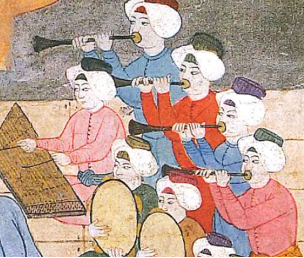
Zurna
TSM 3594, fol. 139a — Zurna, 1720.
A powerful double-reed instrument used in outdoor, ceremonial, military, and festive settings, restoring sound relationships that cannot be represented convincingly by indoor art-music instruments alone.
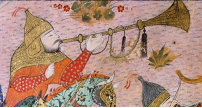
Nefir / boru
Uppsala University Library, O Nova 2 — Battle Scene (f. 26a detail), Dastan-i Jamal u Jalal. 1502–1505, Tabriz.
Natural trumpets and signal horns associated with military, ceremonial, and processional contexts. Their research combines textual references with depictions of length, bore, mouthpiece, and manner of carrying; versions are selected for spatial and rhythmic function as much as for pitched material.
Percussion and project instruments
Nakkare
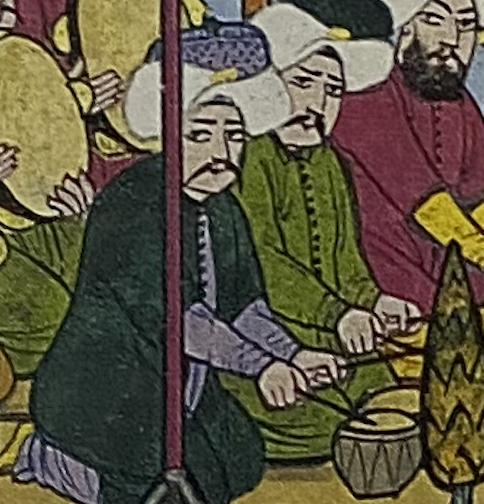
TSM A3593 — Surname-i Vehbi.
Paired or grouped small kettledrums used in courtly, ceremonial, and military settings. Reconstruction research considers bowl proportions, membrane, lacing, sticks, and playing position in relation to miniatures and written accounts.
Def and bendir
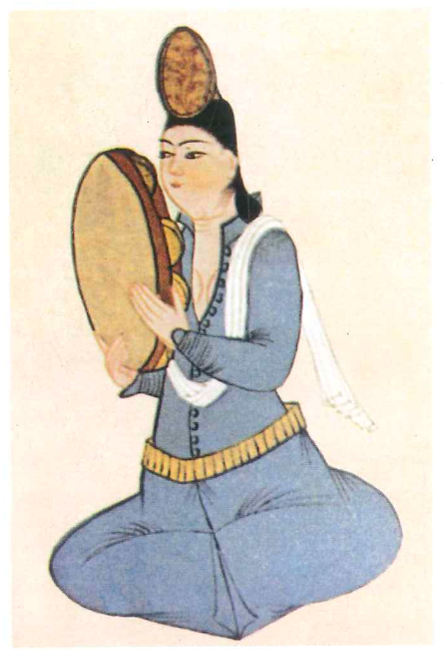
Biblioteca Comunale dell’Archiginnasio, Bologna, A 365, 24.
Frame drums found across Ottoman musical contexts. Variations in size, construction, jingles, and technique provide colours ranging from delicate support to ceremonial resonance.
Davul
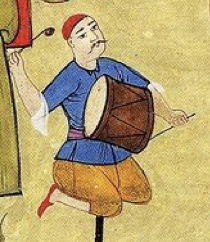
TSMK, Surname-i Vehbi, fol. 104.
A large double-headed drum associated particularly with outdoor, military, and festive music, used selectively for weight, direction, and physical scale.
Çegane
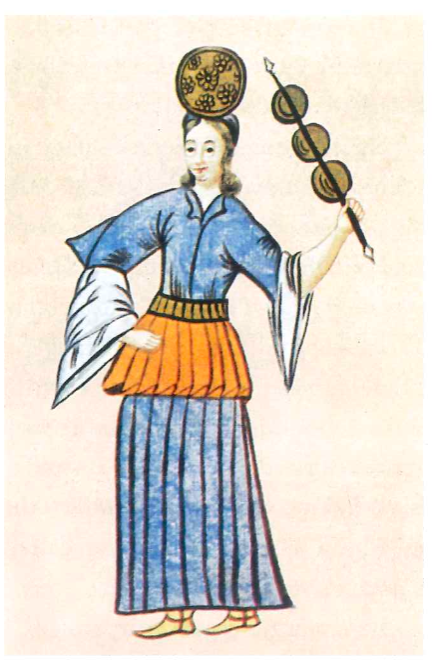
Metin And slide archive.
A rhythmic instrument associated with jingling metal elements and ceremonial movement. Terminology and construction differ between sources, so its use is determined by project context.
Project-specific configuration
Ensemble Rûm does not use every instrument in every programme. Instrumentation is rebuilt around each project’s historical period, geography, primary sources, repertory, and venue. The final cast sheet identifies whether each touring instrument is a project reconstruction, a historically configured instrument, or a present-day related instrument.